ACT New Zealand — 2026 Election Feasibility Report
1. Party snapshot
- Leader: David Seymour (verified; Epsom MP, leader since 2014, Deputy Prime Minister since 31 May 2025).
- Position: junior partner in the governing National–ACT–NZ First coalition; ACT holds associate Finance, Health, Education and Justice, plus Internal Affairs, Courts, Workplace Relations and Biosecurity portfolios.
- 2023: 8.64% party vote, 11 seats. Current poll: 9–12% (RNZ–Reid 10.1%; 1News–Verian 12%, a term high).
- Themes: manifesto "Plan to Unlock New Zealand's Potential" (released 26 Oct): no new taxes, $22bn in cuts / $12.4bn less debt by 2031, no tax on KiwiSaver earnings, Three Strikes for Burglary, "one law for all", cost of living; dropped the PR-visa scrapping pledge, now wants future PR holders to stay 2 of 5 years.
- Coalition posture: "re-elect the Coalition"; rules out Labour, Greens and Te Pāti Māori ("Lock Labour Out") but would rather govern with Opportunity than oppose Labour.
2. Key policies & feasibility
Economy/fiscal - $22bn spending cuts / $12.4bn less debt by 2031 — fully costed across lower budget allowances, non-frontline cuts and welfare savings, targeting surplus a year earlier — feasibility: 4 — partly delivered (Budget 2026's ~12% ministry cuts), but deep cuts in a weak economy (GDP +0.2%), and most survive only if the coalition agrees (constraints 1, 7). - KiwiSaver: untax qualifying earnings, scrap the government contribution — self-funded tax break so returns stay invested — feasibility: 3 — simple legislation, but regressive (Greens: "welfare for the wealthiest") and qualifying-investment rules are underspecified (constraints 1, 2). - NZ Super age to 67 by 2035 — +3 months yearly, early access for physically demanding jobs — feasibility: 4 — simple statutory change with real savings (constraint 1), though politically costly and the "compassionate" carve-out is vague.
Housing - Continue RMA/planning reforms — implement new planning laws, MDRS optional, national instruments, faster consenting — feasibility: 4 — already in motion with ACT holding the levers and consents +21% (constraint 5), but supply lags 2–5 years. - End loss ring-fencing for future rental losses — let landlords offset rental losses against other income — feasibility: 3 — a tax rule within Government power, but unfunded (constraint 1) and demand-side incentives fit poorly in a supply-constrained, falling-price market (constraints 3, 5).
Health - $400m general practice uplift + pharmacists treat minor ailments — over four years, under GP oversight — feasibility: 4 — modest, funded, within Government power; the classic hospital-to-primary shift, effects hinging on capacity build. - $2bn New Zealand Cancer Centre — national centre with campuses in Auckland and Christchurch — feasibility: 3 — costed capital within Government power, but a multi-site build at 4.8% 10-yr yields (constraint 2) is a decade-plus programme with delivery risk.
Education - Voluntary Student Services Fee — pay only for services you use, instead of ~$1,132–1,253/yr compulsory — feasibility: 5 — TEF Act regulation change, costless, within Government power; ~$4,000/degree saved goes straight to students. - $500 investment account for every Year 11 student — Sharesies-style, funded by ~5% of the KiwiSaver subsidy (~$50m/yr), phasing into real investing — feasibility: 4 — costed, within Government power, administratively feasible with AML reforms underway.
Climate/energy - Scrap Climate Change Commission, repeal Zero Carbon Act incl. net-zero, renegotiate Paris — feasibility: 3 — the first two are simple statutory acts, but the treaty is outside Government control and repeal raises investment uncertainty (constraint 4). - Remove ETS price floor + Carbon Tax Refund — drop the "artificial" floor, return ETS auction revenue to households — feasibility: 3 — mechanically simple and could ease fuel/power costs mid-crisis (constraint 4), but forgoes revenue when fiscal space is tight (constraint 1).
Employment - Three-year minimum wage freeze + 60% training wage for under-20s in year one — feasibility: 3 — mechanically simple, but in a soft labour market (unemployment 5.6%) risks entrenching low wages with little proven employment benefit (constraints 3, 6).
Justice/crime - Three Strikes for Burglary — third burglary conviction means ≥3 years without parole; plus 100,000 extra rural police patrol hours and a rural crime unit — feasibility: 4 — simple sentencing law consistent with ACT's in-government record, low cost.
Governance - Consolidate to 19 departments, 18 ministers; stronger minister power over chief executives — feasibility: 4 — within Government power under State Services legislation, consistent with past reshuffles; savings modest but on-brand.
3. Overall feasibility verdict
ACT is the campaign's only fully costed plan, and most items are statutory or executive changes partly delivered already in Government — strong on small regulatory moves, weak on multi-billion capital and treaty-level climate policy (average ≈3.4/5). Most feasible: Voluntary Student Services Fee (5); $22bn cuts / debt path (4); Three Strikes for Burglary (4). Least feasible: ETS floor removal + Carbon Tax Refund (3); climate/Paris rollback (3); minimum wage freeze + training wage (3).
4. Democratic-stability note
ACT is the most institutionalised minor party — long-term leader, Deputy PM, three years in office — which lends predictability, and hard rule-outs of the left lower the risk of a fractious cross-ideological coalition, with a path to power via Opportunity still possible. Conduct is mixed: the manifesto deliberately distinguishes ACT from its partners, National complained over an ACT/NZ First split-vote campaign (coalition friction), and confrontational rally rhetoric plus the "one law for all" platform (removing compulsory karakia, winding up the Waitangi Tribunal) risks inflaming social fault lines rather than stabilising them.
5. Young-people outlook note
Direct gains: voluntary Student Services Fee (~$1,100–1,250/yr back, ~$4,000 over a degree) and the $500 Year 11 investment account; the wage freeze and 60% under-20s training wage cut entry-level pay in a soft labour market. Housing reform works but with a 2–5 year supply lag (constraint 5), so late-2020s first-home buyers get little near-term relief; the KiwiSaver tax break favours older, wealthier accumulators at 4.8% 10-yr yields (constraint 2). Scrapping the ETS floor may ease fuel bills short-term, but the climate rollback weakens the long-term outlook.
Late campaign updates
- 30–31 Oct 2026: ACT confirmed to the Post that it authorised the Don Brash overhang/split-vote ad (00 §6) — explicitly optimising ACT's party vote over National's against National's opposition; coalition friction in the final week (no policy/score change).
6. Sources
- https://www.rnz.co.nz/news/politics_election-2026/2163416/act-publishes-manifesto-with-22b-in-cuts-ditches-migration-promise
- https://www.stuff.co.nz/politics/361051057/act-promises-124b-less-debt-2031-election-manifesto
- https://www.interest.co.nz/sites/default/files/2026-10/ACT%27s_Plan_to_Unlock_New_Zealand%27s_Potential.pdf
- https://www.act.org.nz/fiscalplan
- https://www.rnz.co.nz/news/politics_election-2026/1839100/act-sets-out-plan-to-raise-retirement-age-cut-debt-spending-and-disability-benefits
- https://www.greens.org.nz/greens_call_out_luxon_s_coalition_proposing_welfare_for_the_wealthiest
- https://newswire.nz/a/796otrkrdDENKoIX2p2JANrc9gM/the_manifesto_includes_500_investment_accounts_for_every_year_11_student_removal_of_tax_on_kiwisaver_earnings_400m_more_for_general_practice_and_three_strikes_for_burglary.html
- https://www.rnz.co.nz/news/politics/953827/act-wants-to-make-student-services-fee-voluntary
- https://www.rnz.co.nz/news/politics_election-2026/feature/health-policy-guide
- https://www.electionresults.govt.nz/electionresults_2023/
- https://www.1news.co.nz/2026/10/29/your-guide-to-the-elections-coalition-red-lines-whos-ruled-out-who/
- https://www.nzherald.co.nz/nz/politics/act-leader-david-seymour-would-work-with-opportunity-if-it-kept-labour-out/AIXMTDFRHNFQVAEXAX7JCAKPDQ/
- https://www.1news.co.nz/2026/10/27/poll-coalition-has-path-to-power-but-labour-steady-amid-gangs-row/
- https://www.dpmc.govt.nz/our-business-units/cabinet-office/ministers-and-their-portfolios/ministerial-list
- https://www3.parliament.nz/en/mps-and-electorates/members-of-parliament/seymour-david/
- https://www.rnz.co.nz/news/politics/587326/opposition-parties-react-to-auckland-housing-u-turn
- https://partymap.co.nz/parties/act/
Graph (extra page)
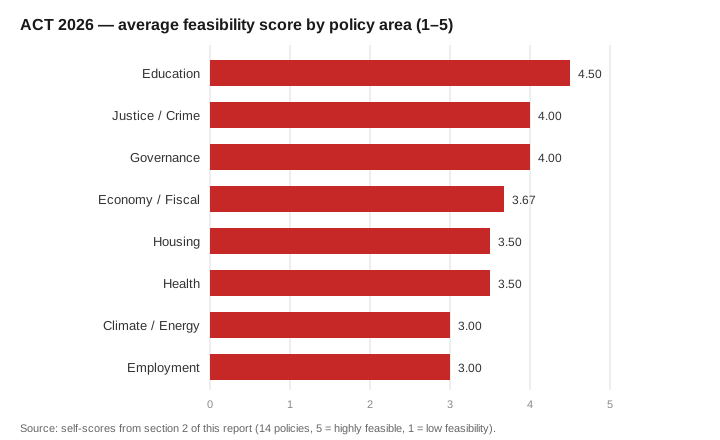 Averages of section-2 scores (1–5) by policy area: education and small governance/justice measures highest; climate/energy and employment lowest.