Green Party — 2026 Election Feasibility Report
1. Party snapshot
- Leaders (verified): Marama Davidson & Chlöe Swarbrick (co-leaders); Swarbrick is finance/cost-of-living spokesperson.
- Current position: polling 14–16% — a sharp rebound from 2023: 330,907 party votes (11.61%), 15 seats (3 electorate + 12 list).
- Key themes: "affordable living" (housing, power, transport, groceries), "healthy nature" (climate), "real democracy" — paid for by taxing the super-rich and mega-corporations and cutting income tax for 96%.
- Coalition posture: wants a change of government; categorically rules out a coalition with National ("of course it's a no"); realistic partner is Labour (possibly with Te Pāti Māori / Opportunity), with red lines — after the gang-pad photo, Hipkins barred Greens from police/corrections and shut Swarbrick out of the finance ministry.
2. Key policies & feasibility
Scale: 5 = highly feasible … 1 = low; NS = unscoreable.
- Fiscal package — nine new taxes (~$28.75bn) funding ~$49bn of spending, plus income-tax cuts for 96%. Wealth, capital-acquisitions, big-corporations, banks and big-tech taxes plus landlord reversals fund the ~$49bn (gap debt-financed). — feasibility: 2 — "who pays" is identified, but the revenue base is hard to collect and it pushes net debt to ~44% of GDP at multi-decade-high yields with negative ratings outlooks [C2].
- Housing supply — build "tens of thousands" of new public homes to clear the waitlist, via council/community-provider financing. — feasibility: 3 — a sound supply response, but capped by builder capacity, land and ~4.8% financing over a 2–5-year lag [C5].
- Housing reform — cap rent increases at 2%/yr + national landlord register + a "rental WOF." — feasibility: 3 — the register/inspection parts are doable, but the 2% cap is contested and could dampen rental supply [C5].
- Health — +$3bn per year for four Budgets ($30bn). — feasibility: 2 — a major sustained operating-cost growth that worsens the deficit/debt path when the surplus only returns from FY2029/30 [C1, C2].
- Health — free primary healthcare (free GP visits). — feasibility: 3 — within government powers and a clear cost, but wholly contingent on the fiscal package holding.
- Education — fees-free tertiary + student debt write-off + universal student income. — feasibility: 3 — specific and within powers, but the one-off write-off plus recurring student income are heavy near-term costs [C1].
- Education & childcare — free ECE for all ($5.38bn) + free school lunches ($1.82bn). — feasibility: 3 — popular and within powers, but large recurring costs contingent on the funding package and junior-partner agreement [C1, C7].
- Climate — full fossil-fuel phase-out by 2035, with Te Tiriti-grounded governance. — feasibility: 3 — directionally feasible and hedges the fuel-crisis risk [C4], but a 2035 deadline is aggressive given electrification capital and financing [C3].
- Energy — Kiwipower, a $981m public power company + zero-interest solar loans for tens of thousands of homes. — feasibility: 4 — specific, costed, within powers, and directly relevant to the fuel crisis [C4]; condition is the fiscal plan holding.
- Employment — Youth Jobs Guarantee ($4.9bn). A guaranteed paid job for every 16–24-year-old unemployed 6+ months, via the Mayor's Taskforce for Jobs across all 67 councils (~32,000 jobs). — feasibility: 4 — concrete, costed, builds on a proven program and existing councils; a declared pilot, so conditions are fiscal headroom and 67-fold scaling.
- Transport — $21.1bn for passenger rail / mass rapid transit + free or capped fares. — feasibility: 2 — the largest commitment, a massive capital programme at multi-decade-high yields with a record of rail cost overruns, hard to sell to junior partners [C2, C7].
- Food / cost of living — KiwiMart (public supermarket, ~$2.8bn) + ban price gouging + $150m/yr food-security grants. — feasibility: 3 — the price-gouging ban and grants are within powers and targeted, but state-enterprise retail is unproven and costly [C1].
- Justice/crime — an "evidenced, health-based approach to alcohol and other drugs," moving away from the war on drugs. — feasibility: 3 — clear in direction and within powers for health/diversion, but less costed, and Labour's post-gang-pad bar on Greens holding police/corrections limits delivery in the likeliest coalition [C7].
- Governance — "real democracy": lobbying register + code of conduct, cap donations at $30,000, voting age 16, restore voting rights in custody, and a constitutional conversation. — feasibility: 4 — the electoral/lobbying reforms are specific, low-cost, within powers and have cross-party support; the constitutional piece runs longer.
3. Overall feasibility verdict
The most fiscally expansionist platform of the serious contenders — a coherent, detailed ~$49bn, nine-tax programme — and the least "feasibility-safe" in the current macro environment: it deepens debt to ~44% of GDP at multi-decade-high yields [C2] while the surplus only returns from FY2029/30 [C1], and several flagships hit budget, cost and coalition limits [C5, C7]. Most feasible: Kiwipower (4), Youth Jobs Guarantee (4), "real democracy" reforms (4). Least feasible: the debt-financed fiscal package (2), the +$3bn/yr health increase (2), and the $21.1bn rail/MRT build (2).
4. Democratic-stability note
The Greens are institutionally reformist — lobbying transparency, donation caps, open government, member-driven manifestos — which is pro-stability in the rule-of-law sense. But two conduct facts matter: a Green MP's gang-pad photo forced Labour to bar Greens from police/corrections, and the Greens are openly pressing for the finance ministry and a "heck of a mandate" in a Labour-led four-party coalition. Net: a stabilising reformist in a left bloc, but with real risk of intra-coalition friction over who governs.
5. Young-people outlook note
This is the platform most directly aimed at 18–30s: a youth jobs guarantee, fees-free tertiary with a student-debt write-off and universal student income, free ECE/school lunches, the rent cap and a large public-homes build, plus Kiwipower, KiwiMart and income-tax cuts. The upside for young voters is the largest of any major party; the risk is that the heaviest items (fees-free, write-off, rent cap, public-homes scale) are the most fiscally exposed, so delivery hinges on the funding package and on what Labour concedes in coalition.
Late campaign updates
- 31 Oct 2026: Swarbrick: government ministers have referred a hyperscale AI data centre in Auckland's city centre to Fast-Track (power of ~60,000 homes); the Greens press for full EIAs and renewable cover (their AGM called for a one-year pause on new centres). Campaign attack; no scored-policy change.
6. Sources
- https://www.greens.org.nz/manifesto_2026
- https://www.interest.co.nz/sites/default/files/2026-10/GP%20FISCAL%20PLAN%202026.pdf
- https://www.rnz.co.nz/news/politics_election-2026/2097318/green-party-releases-fiscal-plan-promises-to-increase-health-spending-by-3-billion-each-year
- https://www.scoop.co.nz/stories/PA2610/S00203/greens-literally-campaigning-on-nine-new-taxes.htm
- https://www.scoop.co.nz/stories/PA2610/S00177/chris-hipkins-47-billion-green-problem.htm
- https://www.national.org.nz/news/20261021-simeonbrown
- https://www.greens.org.nz/greens_announce_plan_to_end_homelessness_fix_housing_crisis
- https://www.nzherald.co.nz/nz/politics/green-party-election-housing-policy-rent-increase-caps-a-rental-wof-and-tens-of-thousands-of-new-public-homes/6BHQQUJBEFBWVKLYH6BOND5JNE/
- https://newswire.co.nz/2026/07/greens-kiwipower-980-million-public-power-company-solar-loans/
- https://www.1news.co.nz/2026/07/20/greens-pledge-kiwipower-to-boost-renewables-and-cut-power-bills/
- https://www.greens.org.nz/greens_launch_plan_to_break_up_the_supermarket_duopoly_and_bring_down_the_price_of_food
- https://www.1news.co.nz/2026/09/06/greens-propose-new-supermarket-chain-in-bid-to-cut-grocery-costs/
- https://exa.ai/library/podcast/833cwn9kt4b/episode/kr81q2vdpcj
- https://www.electionresults.govt.nz/electionresults_2023/statistics/overall-results-summary.html
- https://www.1news.co.nz/2026/10/30/your-guide-to-the-elections-coalition-red-lines-whos-ruled-out-who/
- https://thespinoff.co.nz/politics/30-10-2026/a-definitive-guide-of-election-2026-rule-outs-as-of-right-now
- https://www.newstalkzb.co.nz/on-air/wellington/wellington-mornings-with-nick-mills/audio/marama-davidson-greens-co-leader-in-studio-with-nick-mills/
- https://www.phcc.org.nz/briefing/election-2026-political-parties-positions-lobbying-political-donations-and-other-pro/
- https://www.rnz.co.nz/news/politics/799663/greens-unveil-election-manifesto-at-packed-agm-in-auckland
Graph (extra page)
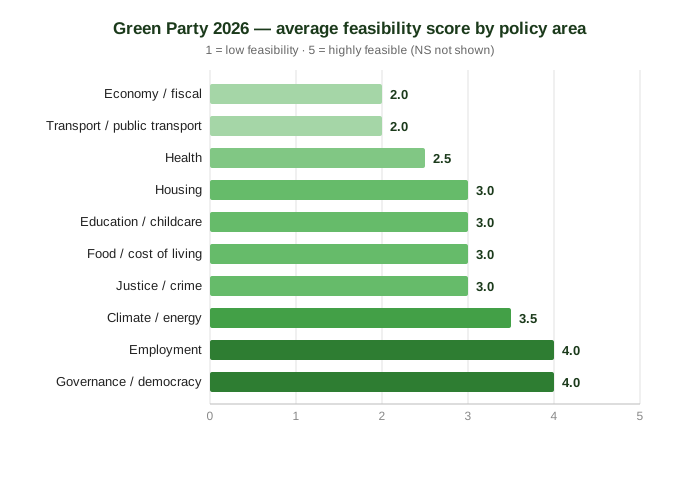 Average feasibility score (1–5) for each of the 14 policies grouped by policy area; the small, costed items (energy, employment, governance) rate highest, while the debt-financed fiscal, health and transport commitments rate lowest.