2026 NZ Election — Meta-Analysis & Party-Vote Recommendation (non-binding)
For the owner (goals: 1 stable democracy, 2 a future for young people). As of Friday 31 Oct 2026; polling day Saturday 7 Nov.
Changelog - Sun 1 Nov 2026 (overnight update): polling unchanged (no new polls since the 20–26 Oct fieldwork). No substantive policy change → no score changes, composites/ranking unchanged, recommendation unchanged (Labour). New context: ACT and NZ First authorised the Don Brash split-vote/overhang ads (right-bloc friction; 00 §6); Peters ruled out governing with Opportunity (OP's National-led path now doubly closed; 05, 08); Hutt South in doubt for Bishop (01); Hormuz blockade still on — Qatari-brokered "positive progress", direct talks Doha 1 Nov, US strike window from 4 Nov if talks stall (00 §3).
1. Method
Seven parties scored 1–5 on stability (can it form/hold a stable government in the 61-seat maths, given its own and others' rule-outs; institutional/rule-of-law tone; coalition track record; conduct this campaign) and young-people future (substance of the 18–30 package, weighted by the report's feasibility scores: a promise that can't be delivered is not a future). Composite = 50/50. Feasibility columns are each report's overall verdict; the baseline (00) is authoritative. United Future excluded — dissolved 2017, de-registered 2018, not on the ballot (07).
2. Party scores
| Party | Stability | Youth | Composite | Feasibility (ref) |
|---|---|---|---|---|
| Labour | 4.0 | 4.0 | 4.0 | ≈3.8 |
| Green | 3.5 | 3.5 | 3.5 | ≈3.0 |
| National | 4.0 | 3.0 | 3.5 | ≈3.7 |
| ACT | 3.5 | 3.0 | 3.25 | ≈3.4 |
| NZ First | 3.0 | 2.5 | 2.75 | ≈3.1 |
| Te Pāti Māori | 3.0 | 2.5 | 2.75 | ≈3.0 |
| Opportunity | 3.0 | 2.5 | 2.75 | ≈3.1 |
≈ = my average of the report's per-policy scores; others are its stated verdict.
Labour — Stability: polls first, governed with the Greens 2020–23, real governance agenda (independent PBO, lobbying reform — feasibility 5); Leoni shows weak candidate vetting (02; 00 §6). Youth: the most targeted, costed 18–30 package (loan write-off, 5% deposit, SolarSaver, fare cap, lunches — feasibility 4–5); demand-side, so slow on housing (02).
Green — Stability: institutionally reformist (lobbying register, donation caps — feasibility 4); but the gang-pad photo forced Labour to bar Greens from police/justice; the Finance push flags post-election friction (04; 00 §6). Youth: the largest upside — a costed $4.9bn Youth Jobs Guarantee (feasibility 4), fees-free + write-off + student income, free ECE/lunches, rent cap — but the heaviest items are most fiscally exposed (04).
National — Stability: incumbent with a proven three-party formula, likely to reach 61+ on a Verian-type result; a maximalist leader (no PM sharing, Finance in-house, Opportunity ruled out) narrows options, raises hung risk (01; 00 §6). Youth: feasible wins (student-loan rate 10%, feasibility 5; Baby Boost; 27 weeks' leave), but demand-side housing, a welfare package that hits 18–30s hardest, and the weakest climate trajectory (01).
ACT — Stability: the most institutionalised minor party (Deputy PM, three years in office, hard rule-outs), but "one law for all" rhetoric (Waitangi Tribunal abolition) risks inflaming fault lines; nothing for stability if the left wins (03). Youth: the voluntary Student Services Fee (feasibility 5) and $500 Year 11 account are real, but a wage freeze + 60% under-20s training wage cuts entry-level pay; housing lags 2–5 years (03).
NZ First — Stability: the most experienced coalition operator, almost certain to rejoin a National-led government; citizens-only voting/NZ Super, a Māori-electorates referendum, the "severe learning difficulties" remark add polarisation; 31 Oct: explicitly ruled out governing with Opportunity (05). Youth: $1,000-at-birth KiwiSaver and free apprenticeships are unfunded or uncosted; infrastructure-first housing risks slowing supply; no near-term rent relief (05).
Te Pāti Māori — Stability: predictable under MMP (one-person list, accepts junior partner), but 2025 internal conflict (expelled MPs in court) and the gang-pad hui; hardline justice/neutrality agenda is a defined friction source, Labour has ruled TPM MPs out of justice (06). Youth: a $30k tax-free threshold and $25 minimum wage lift first-job income, but big items are unfunded and closing youth residences by 2030 (feasibility 1) is blocked by Labour (06).
Opportunity — Stability: never held a seat, five leaders in a decade, but published bottom lines and clean-up politics (feasibility 4); ~6–7 seats make it a decisive hinge — either restraint or a propped-up minority (08); 31 Oct: Peters' rule-out closes the National-led path (08). Youth: $370/week from age 18 is the most direct floor on living costs, but feasibility 2 (10-year transition, contested LVT funding) and KiwiSaver 2.0 blocks first-home-deposit withdrawals (08).
3. Ranking + sensitivity
Composite (50/50): 1. Labour 4.0 · 2. Green 3.5 · 3. National 3.5 · 4. ACT 3.25 · 5. NZ First / TPM / Opportunity 2.75. Tie-break at 3.5: Green above National on its youth score; National's rule-outs narrow the path to government.
- 60/40 stability: Labour 4.0, National 3.6, Green 3.5, ACT 3.3, others 2.8 → National takes 2nd.
- 60/40 youth: Labour 4.0, Green 3.5, National 3.4, ACT 3.2, others 2.7 → unchanged.
Labour is first under all three weightings; only 2nd place flips (Green ↔ National).
4. Government reality check
List seats: simple proportional allocation of party vote (sub-threshold excluded); electorates from each poll, modest bonus for parties with electorate bases; TPM 6–7 Māori seats. Rough.
| Party | RNZ–Reid (LAB +5.8) | 1News–Verian (NAT +1.6) |
|---|---|---|
| Labour | 34 | 29 |
| National | 32 | 36 |
| Green | 18 | 18 |
| ACT | 13 | 15 |
| NZ First | 11 | 11 |
| Opportunity | 7 | 6 |
| Te Pāti Māori | 7 | 6 |
| Right bloc (NAT+ACT+NZF) | 56 | 62 |
| Left bloc (LAB+GRN+OPP+TPM) | 66 | 59 |
- Verian-type → incumbent National–ACT–NZF forms (62; margin of one seat — fragile).
- Reid-type → Labour–Green–Opportunity–TPM government (66); LAB+GRN alone is 52, 59 with either OPP or TPM.
- Middle result (a "fraction of a point" Post/Freshwater scenario) → both blocs land 59–61: real minority-government risk.
- OPP threshold: at 5.4–7.2% it straddles the 5% line; below it the left bloc loses 4–7 seats (Reid-type left: 59 — cannot form).
- TPM overhang: 6–7 Māori seats on a 0.1–1.9% party vote means 1–2 overhangs (a 121–122-seat Parliament); Leoni's resignation (her name stays on the ballot) could cost Labour Tāmaki Makaurau and add a third.
- Overhang play (31 Oct): the ACT/NZF-authorised ads urging National supporters to party-vote ACT/NZF could tilt the right bloc's seat mix toward ACT/NZF list seats plus National list overhang (protecting list-only MPs like Nicola Willis) — bloc total stays ~56–62; composition shifts. (00 §6)
- Delivery: a right government delivers the three-party common platform (ACT's $22bn cuts, National's loan-rate cut), not the unfunded flagships (BNZ buy-back, $100bn Future Fund); a left government dilutes both platforms — Green's $3bn/yr health, rail and fees-free are most at risk, while Labour's loan write-off, 5% deposits and Green's Youth Jobs Guarantee most likely survive.
5. Recommendation (non-binding)
Party vote: Labour. Top-ranked under every weighting and the only party that plausibly serves both goals: the cleanest path to a stable government (2020–23 track record; the governance agenda serves goal 1) with the most targeted, costed 18–30 package — loan write-off, 5% deposits, SolarSaver, fare cap, lunches (goal 2).
The main trade-off, stated plainly: Labour's fiscal anchor is its weak spot — a 28% CGT that must raise real money in a falling property market, and "debt below 20% of GDP" contradicts every published Treasury path. If the CGT under-delivers, either the youth items get cut or debt rises — a hit to both goals; Leoni shows the vetting weakness.
Runner-up: Green (3.5) — the strongest youth case (the only costed jobs guarantee) and best placed to push Labour toward more youth policy; its transparency reforms serve goal 1. At a 60/40 stability weighting the runner-up becomes National (3.6): a proven incumbent formula if it wins — at the cost of the weakest climate trajectory and the welfare package that hits 18–30s hardest.
MMP note: the party vote is a single choice, not a ranked preference — the runner-up is the alternative if your mind shifts. The two votes are independent: the party vote drives the government (this recommendation's weight); the electorate vote is a local choice with little national effect.
6. Caveats
- As of 31 Oct 2026 (updated 1 Nov): policies and rule-outs can still move before 7 Nov. Fuel-crisis wildcard: the blockade is still on; Doha talks 1 Nov; the US no-strike pause ends 3 Nov, with a reported possible round of strikes from 4 Nov (00 §3).
- Scores are judgements on reported policies, not delivery guarantees; feasibility is a reference, not a promise.
- Polls carry error and the seat maths are rough; Verian-type vs Reid-type changes who can form government.
- Non-binding: the decision is the owner's.
Graph (extra page)
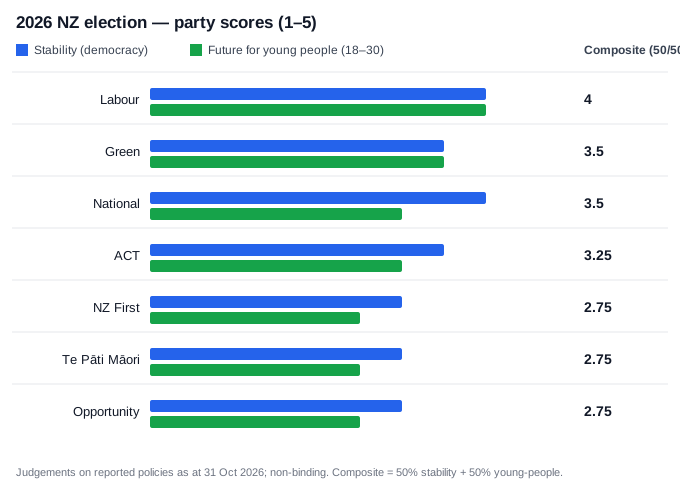 Bars per party: stability (blue), future for young people (green); composite (50/50) at the end of each pair, 1–5 scale.